


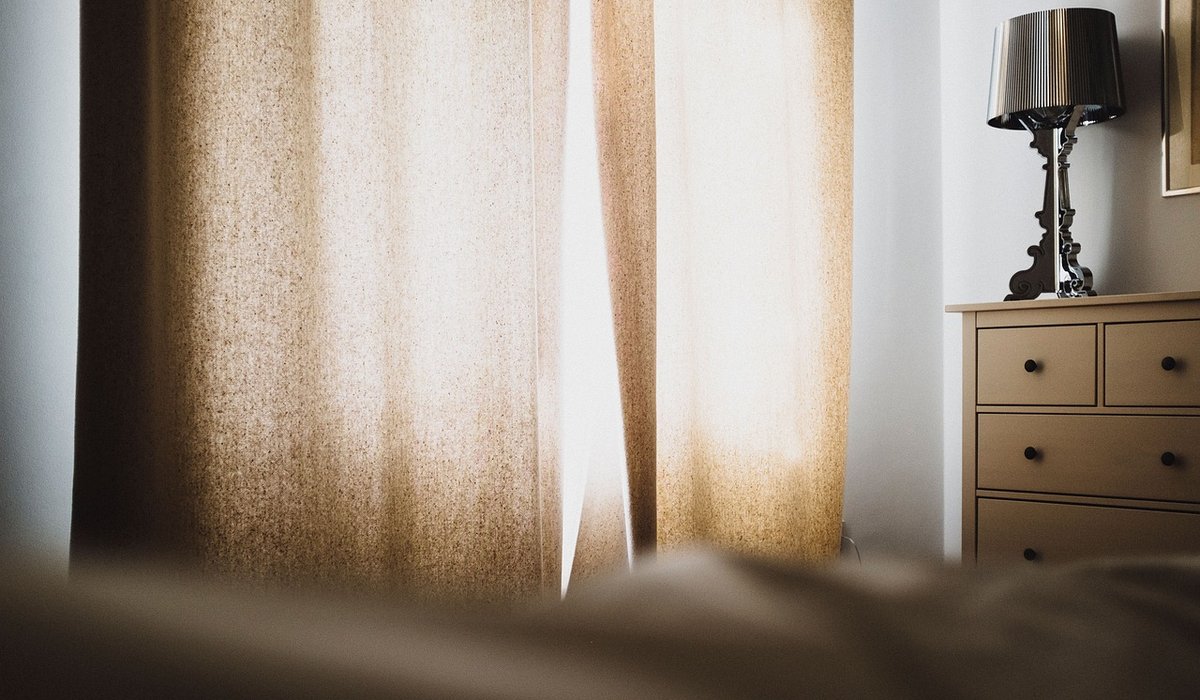
A loft bedroom has a character that the rest of the house rarely matches: sloping ceilings, a glimpse of sky through a dormer, and a sense of being tucked away from everything. It also tends to be the smallest room in the house. The trick isn't to pretend the space is bigger than it is, but to give the eye fewer places to stop and the floor fewer things to trip over. Here's how to make a compact attic room feel calmer, airier and considerably more generous.
Paint the Whole Room Out in One Light Tone
Light colours reflect whatever daylight reaches the loft, but the bigger win is continuity. When the walls, the sloping ceiling and the flat ceiling are all painted the same shade, the eye reads the whole space as one surface rather than three separate planes pressing in on you.
- Choose a soft off-white, warm chalky grey or pale putty. Cool blue-whites turn a north-facing loft grey and slightly bleak.
- Use matt emulsion on the slopes rather than silk or eggshell — flat finishes absorb uneven light and soften the angles.
- Paint skirting, door frames and the window reveal in the same colour, or at most half a shade lighter.
- Always test your chosen colour on the slope itself. Paint behaves differently on an angled surface than on a vertical wall.
Keep contrast for one deliberate accent — a timber floor, a dark headboard, a single piece of art — so the room has somewhere for the eye to rest without feeling chopped up.
Take the Flooring Right to the Eaves
This is the single most effective change in most lofts, and it's often overlooked. Where flooring stops at the knee wall and a strip of plasterboard drops to the floor, the usable floor visually shrinks by half a metre or more.
- Fit carpet, laminate or LVT past the eaves line and into the low void, even if you can only see it from a crouch.
- If planning permission or insulation detailing requires a boxed section, keep the boxing shallow and finish it in the wall colour so it reads as part of the wall.
- Run floorboards or plank-effect flooring lengthways towards the window. Long lines pull the eye out to the view.
- Avoid a visible metal stop bead at the eaves — a continuous surface is worth the extra fitting time.
If you have under-eaves voids, use hinged access panels rather than fixed plasterboard. That dead space is prime storage, and it costs nothing in floor area.
Choose Furniture That Shows Its Legs
Bulky pieces with solid bases look as though they're sitting on the room. Furniture on visible legs lets the floor run underneath, and that glimpse of continuous surface is what sells the illusion of space.
- Choose a bed with tapered legs or a slim metal frame rather than a solid-sided divan base.
- Use wall-mounted or floating bedside shelves instead of chunky cabinets — they free up the floor beneath and suit the tight gap beside a chimney breast.
- Favour open rails, low chests of drawers and glass-topped or acrylic pieces over tall, deep wardrobes.
- Measure the knee wall height before buying anything. A 900 mm chest of drawers will fit neatly beneath a 1.1 m slope; a 1.2 m one simply won't.
Where head height is genuinely tight, let the low zones do quiet work: a row of low baskets, a bench, a stack of books. Just keep the tall side of the room for anything you need to stand up to use.
Let the Daylight and Reflections Work Harder
Most loft rooms have one principal window, usually a dormer or a rooflight, and it's doing a lot of heavy lifting. Don't crowd it.
- Keep the window reveal clear. A roller blind fitted inside the reveal takes up almost no visual space; heavy curtains on a long pole swallow the wall.
- Hang a mirror on the flat gable wall or opposite the window so it bounces light back into the room.
- Layer lighting deliberately: wall lights on the vertical wall, a slim LED strip tucked under the eaves shelf, and a single pendant or rooflight uplighter.
- Paint rooflight reveals and window frames in the same light tone as the walls so the opening reads as part of the surface.
Keep Surfaces Clear and Storage Discreet
Clutter is what makes a small room feel small. A few well-chosen storage moves will do more than any decorating trick.
- Use under-bed drawers or shallow boxes on castors, but check they clear the bed frame legs.
- Fit hooks on the back of the door and a slim shoe rack rather than a freestanding unit.
- Limit artwork to one considered piece or a single row of small frames, hung at eye level from the tallest part of the room.
- Choose a couple of large baskets over many small containers — fewer, bigger objects calm a space.
Finally, keep a walking route clear from door to window. When you can cross a loft bedroom without sidestepping, it stops feeling like a storage cupboard and starts feeling like a proper room — which, with the right light and a little restraint, it very much is.


Leave a reply